Why We Spend Four Hours Breaking Down Your Business Before We Build Anything
Discovery is not a sales meeting. It is the session where we map every workflow, find the bottleneck, and design the roadmap — before a single line of code gets written.
By Justin Hinote
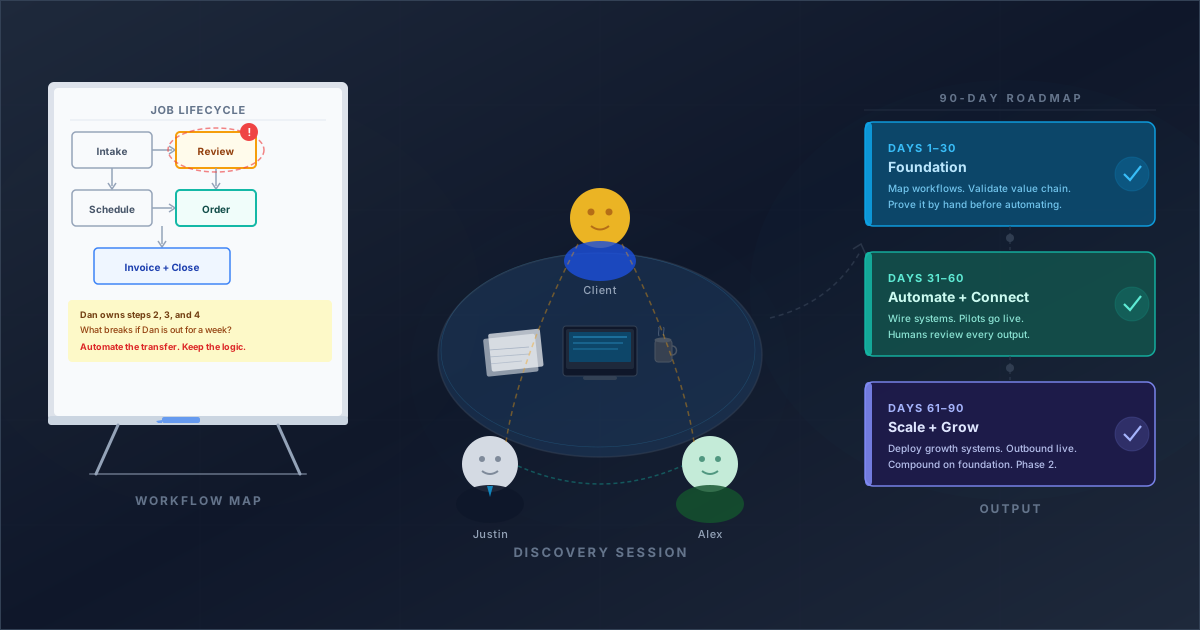
Every established business has one person like this.
They have been there for a decade. They know every vendor relationship, every system workaround, every exception to the exception. When something breaks, the phone rings and their number comes up. When a new person starts, they shadow this person for two weeks because there is no documentation that could replace the real thing.
They are good at what they do. Often exceptional. And they are quietly exhausted.
This person is not just an employee. They are the system. Every process that should live in software lives in their head instead. Every workflow that should be automated runs through their inbox. They are talented enough to hold it together — and that talent is exactly why no one has ever forced the business to confront what would happen if they left.
When an AI vendor skips real discovery and leads with a demo, they miss this person entirely. They map the org chart, not the actual operation. They build automation for the surface — the forms, the dashboards, the intake flows — while the real leverage sits untouched.
That is the problem discovery is designed to solve.
What Discovery Is Not
Discovery is not a sales meeting.
It is not a dog-and-pony show where we walk you through our capabilities. It is not a vendor orientation where you educate us on your industry from scratch. It is not a one-hour Zoom where we collect requirements and disappear to write a proposal.
Most companies selling AI services skip straight to the proposal because the proposal is where scope gets defined and scope is where revenue gets set. That creates a bad incentive. It rewards guessing and punishes rigor. It produces projects that look right on paper and land wrong in practice.
We do it differently.
Before we build anything, we spend four hours with your team — on-site, in your systems, working through your actual operation. Not the operation you describe in a summary email. The one that actually runs on a Tuesday morning when three jobs are active, one vendor is delayed, and the person who knows where the critical documents live is on another call.
How We Prepare Before We Walk In
Discovery is not the beginning of our research. It is the deepest part of it.
Before we arrive, Alex and I have reviewed every note from our initial conversation. We have mapped the software your business runs on and identified where those systems typically break down — and where they have open APIs. We have built an internal agenda, block by block, with specific questions for each part of your operation.
We know your industry well enough to ask the uncomfortable questions. What we do not know yet is where the real friction lives inside your specific operation. That is what the four hours are for.
We are not exploring with you. We are excavating with you — and we have a map of where to dig.
The standard we hold ourselves to before walking in the door: we should be able to demonstrate, in the first fifteen minutes, that we have already done more work understanding your business than most vendors do across an entire engagement.
What Four Hours Together Looks Like
The session runs in four blocks. Each one builds on the last.
Block 1: Current State and Operations (50 minutes)
This block is not for the founder. It is for the person who runs the day.
We want to map the full lifecycle of a job, a client, or a transaction — whatever the core unit of work is in your business — from the moment it enters the system to the moment it is complete and closed. Every step. Every person who touches it. Every place where information gets entered more than once, or where someone has to check three places to find the answer to one question.
We start by asking the operations lead to walk us through a real, active job. Not a hypothetical. Not a cleaned-up example. An in-progress record with all the messiness attached.
Then we listen without interrupting for two to three minutes.
What comes out in those minutes is usually more valuable than anything we could extract with directed questions. The workarounds. The informal systems. The steps that exist because "that's just how we do it" with no other explanation.
We draw the lifecycle on a whiteboard together, with the ops lead driving. Every handoff gets marked. Every manual entry point gets circled. Every system involved gets named.
What we are specifically listening for:
- "I just handle that." Any time the answer to a process question is "I handle that" with no elaboration — that is where a business is most fragile, and often where automation creates the most immediate value.
- "We lose track." / "Things fall through." These are alert and dashboard opportunities. Not glamorous, but high-impact.
- Anything requiring multiple systems to answer one question. If getting one answer requires opening three tabs, that is an automation target.
- Volume. How many units per week. How often things go sideways. How different peak periods are from baseline. These numbers drive the ROI math.
By the end of Block 1, we have a documented lifecycle map and a prioritized list of friction points. Most businesses have never had this on paper before.
Block 2: Systems and Technical Audit (60 minutes)
This block is where we stop talking about your systems and start looking at them.
We ask someone to drive — not narrate — their primary platform. Pull up a real in-progress record. Click through the actual workflow, not a demo walkthrough.
While they drive, we are confirming:
- What integrations are actually active (not just purchased or enabled in settings)
- Whether the system has open API access and what it covers
- What automations already exist, even informal ones
- Where data lives outside the primary system — the spreadsheets, the shared drives, the email threads that function as a de facto database
- The user structure: who has access to what, who makes configuration changes, who is the de facto system administrator
This matters because scope without a technical audit is theater. We do not want to promise an automated workflow and discover in month two that the API does not support write access. We confirm what we are building on before we design what we are building.
The architecture decision — whether we are using the system's API, browser automation, a hybrid approach, or a custom data pipeline — gets made here, in the room, with your actual system in front of us. Not in a proposal written from memory a week later.
Block 3: Growth Opportunity (45 minutes)
Operations discovery finds the bottleneck. Growth discovery asks what becomes possible when the bottleneck is removed.
This is a different kind of conversation. Block 1 was about cost, friction, and fragility. Block 3 is about revenue, capacity, and timing.
Every ops problem has a revenue consequence. The team too busy processing jobs to respond to inbound leads in time. The operations lead who is the single point of failure and cannot also run a referral reactivation campaign. The business that processes work manually and cannot scale volume without scaling headcount proportionally.
We open Block 3 with a simple reframe: you have already made bets on technology somewhere in this business. Let's talk about what happens upstream and downstream when those bets start compounding.
Typical territory we cover:
- Inbound capacity. How are leads coming in today. What happens when volume spikes. How fast does the first meaningful response go out.
- Outbound potential. Is there any systematic outreach to past customers or warm prospects. What data exists on them.
- Time-sensitive growth windows. Some industries have windows where speed of response is the entire competitive advantage. We want to know what those look like and whether the current operation can move inside them.
- Referral reactivation. The cheapest leads a business will ever get are past customers who had a good experience. Most businesses are not working this list with any consistency.
We are not pitching in this block. We are mapping. The goal is to make sure the roadmap we present in Block 4 includes the full opportunity, not just the operational cleanup.
Block 4: Roadmap Reveal (30 minutes)
This block is where we show our work.
We present a preliminary 90-day roadmap built on exactly what we heard in the previous three blocks. Days 1 through 30, 31 through 60, 61 through 90. What gets built. In what order. Why that sequence.
We frame it clearly: this is not the proposal. The proposal comes after this. This is how we think, shown in real time — a synthesis of the operation we mapped, the systems we audited, and the growth opportunity we uncovered.
The goal is not to sell. The goal is to demonstrate that we connected the dots.
When we present a roadmap that references the specific friction points the ops lead described in Block 1, the specific integration status we confirmed in Block 2, and the specific growth window we identified in Block 3 — the CEO and the ops lead should both leave thinking the same thing: they already understand our business.
That is the only outcome we are after in Block 4. Everything else follows from it.
We end the session by confirming the proposal delivery date, the operating agreement timeline, and what the first thirty days of build would look like if everything moves forward.
What You Walk Away With
Regardless of whether we end up working together, the session produces four things of real value.
A mapped workflow. Most businesses have never had their core operation documented end to end. The whiteboard from Block 1 alone is worth the four hours.
A bottleneck inventory. Every function that lives in one person's head, identified and named. This is the fragility map of your business.
A prioritized automation target list. Ranked by impact and feasibility. Not a list of ideas — a list of specific, scoped opportunities with enough technical context attached to act on.
A preliminary 90-day roadmap. Not a proposal. A thinking document. The foundation the proposal is built on.
When we write the proposal, we are not guessing. The scope comes from what we saw in your systems, heard from your team, and confirmed together in the room. That is why proposals built from discovery sessions land differently than proposals built from sales calls.
How We Work — Five Commitments That Do Not Change
These are not positioning statements. They are operating commitments.
We prove it by hand before we automate it. When we start an engagement, we run the workflow manually first — pulling data, generating outputs, updating systems — by hand. This validates that the logic works before we build software around it. It produces a benchmark dataset. And it catches the assumptions that would have become expensive bugs in month two.
Humans stay in the loop. Every output an AI system generates — a drafted communication, an alert, a scored lead, a completed task — routes through a human reviewer before it touches a customer or a production record. The AI handles the volume. People handle the judgment calls.
Pilot first, production second. We specify upfront which components are pilots and which are production-grade. A pilot is not a broken thing — it is a working, useful system that has not yet been validated at full scale. We do not present pilots as production systems, and we do not slow down production work waiting for pilots to reach perfection.
Scope gets refined together, not guessed upfront. The proposal defines what we are building and how we work together. The detailed scope — the data models, the integration specifics, the architecture decisions — gets finalized during the first week of the engagement, when we are looking at your real systems and making real decisions together. We can start immediately. We cannot scope precisely from the outside.
No surprises. If something is not working, is not worth the cost, or needs a different approach, we say so directly and early. That conversation starts in the proposal — with explicit considerations, stated exclusions, and honest framing about what we know and what we do not yet know — and it continues throughout the engagement.
Who Is in the Room
For every discovery session, it is Justin and Alex on our side.
Justin leads the operations and growth discovery — Blocks 1 and 3 — and runs the technical audit alongside your team in Block 2. He is the one asking the specific, procedural questions that make some people uncomfortable: every step, every document, every click. He has built and run production AI systems for logistics operations, field service businesses, B2B sales teams, and nonprofit development shops. His instinct is to keep going until the actual system is visible — not the version people describe when they want to make a good impression.
Alex manages the relationship between what gets built and what you actually needed. He runs the commercial side of Block 4, confirms the proposal timeline, and owns the client relationship from operating agreement through delivery. He is the person who will tell you if an engagement is not on track before you have to ask.
On your side, we want two people in the room: the founder or CEO, and the person who runs the day-to-day operation. Both voices need to be present. The gap between how a founder thinks the business works and how the ops lead actually runs it is, almost always, where the most valuable automation lives.
The Offer
Discovery is not a sales call with extra steps.
It is four hours of real work, with a real agenda, producing real artifacts. We charge for it because it is valuable independent of whether we build anything together. It is also the only way we know how to write a proposal we can stand behind.
If you have a person in your business who is holding your operation together through force of will and institutional knowledge — and you have been wondering how to protect that capability and build on top of it without burning them out — this session is the right place to start.
We will do the homework before we show up.
Book a discovery session with Alex.
Frequently Asked Questions
What is the difference between a discovery session and a sales call?
A sales call is about fit — whether there is a reason to keep talking. A discovery session is about depth — mapping your operation well enough to scope a real engagement. We spend the first block on current state, the second on your live systems, the third on growth opportunity, and the fourth presenting a preliminary roadmap. You leave with documented workflow maps, a bottleneck inventory, and a prioritized automation target list. We leave with everything we need to write a proposal without guessing.
What does a discovery session cost?
Discovery sessions are a paid engagement. The fee reflects the preparation involved and the value of what gets produced, independent of whether we end up building anything together. Reach out to discuss pricing based on your engagement scope.
What do we need to prepare before the session?
Not much. Have the person who actually runs day-to-day operations in the room — not just the founder. Make sure someone can pull up your primary system and walk through a real in-progress record. If existing documentation of your workflow exists, bring it. If it does not, do not create something new for the session. We prefer to see what actually exists, not what has been cleaned up for a meeting.
Do you work with companies that are not tech-forward?
Yes. Some of our best engagements are with companies that have been operating successfully for years using manual processes and off-the-shelf software. The fact that you have not fully automated does not disqualify you. It means the opportunity is larger. The session is designed to work with your existing systems, not to replace them wholesale.
How long until we see results?
It depends on what we build. Our standard engagement structure targets working, useful outputs within the first thirty days — not a proof of concept, but something running in production that is saving real time or creating real capacity. The manual validation we run in weeks one and two confirms the value chain before automation is built around it. If something does not work by hand, we know before we have spent months building a system around a broken assumption.
What happens after discovery?
We deliver a formal proposal within one week of the session. The proposal defines the engagement scope, the delivery structure, the timeline, and the investment. From there, you review, sign an operating agreement, and we schedule the kickoff. The first week of a full engagement includes a more detailed session — remote or on-site — where final architecture decisions get made against what we confirmed in discovery. From signing to active build is typically under two weeks.
Related Solutions
Get the AI Team Playbook
10 practical AI tools your team can start using today — automations, custom GPTs, AI agents, and prompt frameworks that actually save time.
Want to put this into practice?
Book a 30-minute call. We'll talk through how this applies to your business and where the biggest opportunities are.
Book a Discovery CallRelated Insights
Strategy
The Goal Isn't to Need Fewer People. It's to Afford More of Them.
Most AI conversations start with efficiency and stop there. The real outcome is a business that grows fast enough that your only problem is keeping up.
Read insightOperations
The Back-Office Tax: How Manual Workflows Cost Mid-Market Firms 20% of Their Week
There is a hidden tax inside most mid-market businesses. It does not show up as a line item, but it lives in rekeying, status checks, data copying, and error cleanup. Here is how to find it and remove it.
Read insightAgentic AI
A Trucking Maintenance Shop in Middle Tennessee Doesn't Need an Sdr Team. IT Needs a Swarm.
A shop owner who is great at fixing trucks shouldn't have to be great at sales too. We built an agent swarm that handles prospecting, qualification, follow-up, and booking — so the shop can grow without hiring people it can't afford.
Read insight