The Back-Office Tax: How Manual Workflows Cost Mid-Market Firms 20% of Their Week
There is a hidden tax inside most mid-market businesses. It does not show up as a line item, but it lives in rekeying, status checks, data copying, and error cleanup. Here is how to find it and remove it.
By Justin Hinote
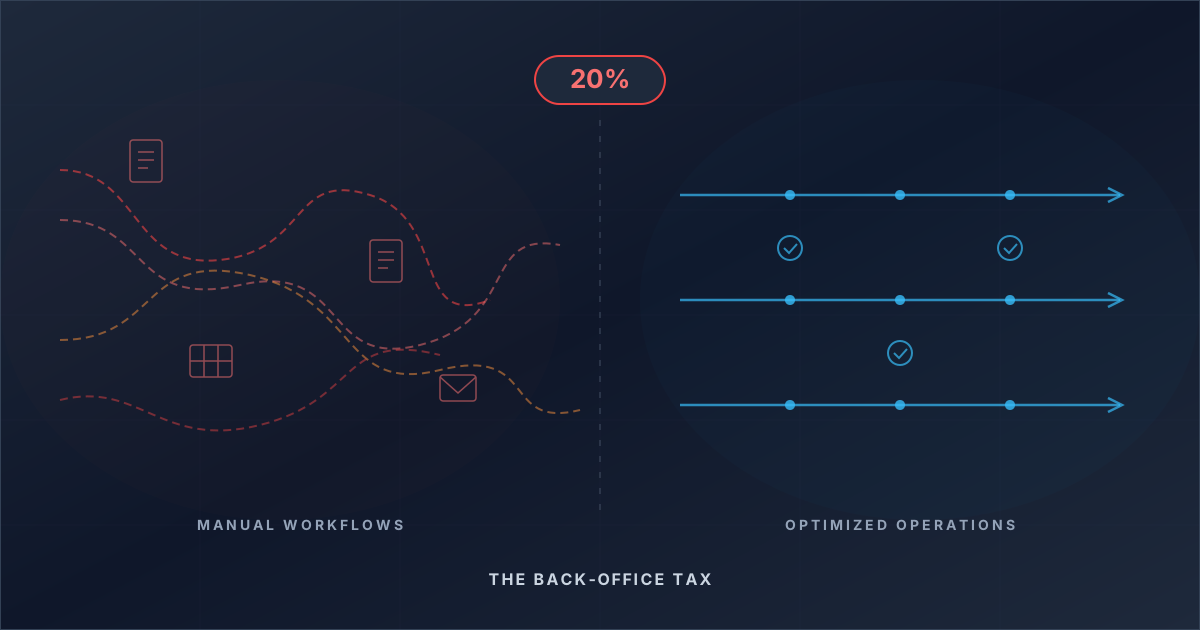
There is a hidden tax inside a lot of mid-market businesses.
It does not show up as a line item. It is not labeled on the budget. No one approves it in a board meeting.
But it is there every day.
It lives in rekeying. In status checks. In copying data from one system to another. In chasing documents. In cleaning up errors that should never have happened in the first place. In the quiet drag of work that feels necessary because it has always been there.
That is the back-office tax.
And in a lot of firms, it is taking something like 20% of the week with it.
The Problem is Not People. It is Workflow Design.
Not because people are lazy. Not because teams are broken. Usually the opposite. These teams are working hard. They are covering gaps. They are protecting the business with spreadsheets, inboxes, side processes, and heroic effort. The problem is that too much of that effort is being spent on work that does not create leverage.
That is the real issue.
Most mid-market companies do not have a strategy problem first. They have a workflow problem. They have critical processes sitting between systems, between people, and between moments of handoff. That is where time disappears. That is where errors are introduced. That is where cycle time stretches. That is where strong operators slowly become expensive routers of information instead of decision-makers. That operating lens is core to how Queen City AI thinks about delivery: business first, workflow second, architecture third, models last.
Start With the Workflow, Not the Tool
A lot of AI conversations still miss this.
They start with the tool. The model. The demo. The chatbot. The agent.
That is usually backwards.
If you start with the tool, you usually end up automating around the edges while the real friction stays untouched. If you start with the workflow, you find the places where labor is being consumed with no corresponding strategic return. That is where the opportunity lives. Queen City AI's core point of view is that AI should be judged by whether it reduces labor, compresses cycle time, eliminates errors, increases throughput, or unlocks proprietary intelligence. If it does not do that, it does not ship.
The Firms That Get Honest Will Separate Themselves
The firms that understand this are going to separate themselves.
Not because they bought more software.
Because they got honest about where manual work is taxing the business.
Take a typical week inside a mid-market company. Someone is re-entering data from a PDF into a system of record. Someone is reviewing invoices or forms that follow a pattern 90% of the time but still require a person every single time. Someone is sending the same follow-up email for the fiftieth time. Someone is validating a spreadsheet against a second spreadsheet because nobody fully trusts the first one. Someone is spending half a day assembling information that already exists in five different places. Those patterns are exactly the kind of high-effort, repeatable workflows Queen City AI targets in practice.
Individually, these tasks do not look catastrophic.
Together, they create organizational drag.
And drag compounds.
It slows response times. It delays billing. It creates avoidable rework. It forces good employees into administrative loops. It makes growth more expensive than it needs to be because the only visible answer becomes adding more people.
AI is an Operating Leverage Project
That is why I keep coming back to the same idea.
AI is not a technology project.
It is an operating leverage project.
The goal is not to make the business look innovative. The goal is to make the business move better.
That starts by identifying the manual friction points that are eating time but not adding judgment. In our work, that often means looking for the double-keying headache, the exception queue, the audit bottleneck, the intake process that still depends on inbox choreography, or the approvals flow that breaks every time it touches an unstructured document. In Queen City AI's own logistics work, these are the kinds of manual workflows prioritized first because they offer immediate ROI and prove that a company can scale volume without scaling the back office.
Tools Without Workflow Design are Noise
This is also why I do not buy the idea that the answer is "just give everyone AI tools."
Tools without workflow design become one more layer of noise.
What mid-market firms actually need is a practical operating model. Clear priorities. Clean handoffs. Real governance. Defined ownership. A measurable outcome window. Queen City AI's standard is simple: baseline the labor hours, error rate, cycle time, and revenue leakage first. If you cannot baseline it, you cannot credibly claim improvement.
The Back-Office Tax Hides Inside Normal
That level of discipline matters because the back-office tax is sneaky.
It hides inside normal.
Teams get used to it.
Leaders start to assume that things simply take as long as they take.
They do not.
A lot of work feels permanent only because nobody has stopped to separate necessary work from legacy work.
The Right Questions to Ask
That is the exercise.
What actually requires human judgment?
What is repetitive but still fragile?
What is rule-based but buried in email?
What is slowing cash cycles?
What is consuming smart people with low-value coordination?
Those are better starting questions than "What AI tool should we buy?"
The firms that answer those questions well will not just save time. They will create capacity. They will protect margin. They will reduce headcount pressure. They will improve speed without accepting more operational risk. That is the standard we use internally too: if an initiative does not connect to labor redeployment, throughput expansion, cash cycle compression, margin protection, risk reduction, or proprietary data advantage, it is a feature, not a strategy.
This is a Growth Issue, Not Just an Efficiency Issue
And that is the real point.
The back-office tax is not just an efficiency issue. It is a growth issue.
Every hour lost to unnecessary manual workflow is an hour not spent on customers, analysis, relationships, quality, or strategy. Every repetitive task left untouched is a quiet vote for slower growth and higher operating cost.
Mid-market firms do not have the luxury of carrying that forever.
The good news is they do not have to.
You do not need a moonshot to start. You need honesty about where the drag is. You need a map of the workflow. You need a clear owner. You need a measurable outcome. Then you build.
No hype. Just results. That outcomes-first, operator-led posture is exactly how Queen City AI frames its work for Charlotte operators and other mid-market teams that need proof, not experimentation.
The businesses that win this next chapter will not be the ones talking about AI the most.
They will be the ones removing the tax.
Frequently Asked Questions
What is the back-office tax?
The back-office tax is the cumulative time lost to manual, repetitive workflows that do not require human judgment but still consume significant employee hours every week. It includes rekeying data between systems, manual status checks, spreadsheet reconciliation, document chasing, and error correction. For many mid-market firms, this hidden cost consumes roughly 20% of the working week across operations teams.
How do I identify back-office tax in my business?
Start by mapping your core workflows end to end. Look for handoff points between systems, between people, and between departments. The tax typically hides in double data entry, inbox-dependent approvals, spreadsheet validation loops, and any process where someone is acting as a human router rather than a decision-maker. Track time spent on these tasks for one week and the pattern becomes clear.
Why should mid-market companies address this before buying AI tools?
Tools without workflow clarity create more noise, not less. If you automate a broken process, you get a faster broken process. The firms that see real ROI from AI start by identifying where manual labor is being consumed without strategic return, then design the automation around that specific bottleneck. This workflow-first approach is how Queen City AI structures every engagement.
What types of manual workflows should be automated first?
Prioritize workflows that are high-volume, rule-based, and currently error-prone. Common starting points include intake processing, invoice review, data reconciliation between systems, follow-up email sequences, compliance documentation, and scheduling coordination. The best candidates are tasks where the logic is repeatable but the execution still requires a person today.
How does Queen City AI help companies reduce the back-office tax?
Queen City AI baselines the current state first: labor hours, error rates, cycle times, and revenue leakage. From there, the team maps the workflow, identifies the highest-ROI automation targets, and builds AI-powered solutions that connect directly to measurable outcomes. The standard is simple: if it does not reduce labor, compress cycle time, eliminate errors, or increase throughput, it does not ship.
What results can mid-market firms expect from workflow automation?
Results vary by industry and workflow complexity, but common outcomes include 40-70% reduction in time spent on targeted manual processes, significant error reduction in data handling, faster billing and cash cycles, and the ability to scale volume without proportionally scaling headcount. The key metric is capacity created, meaning hours redirected from low-value coordination to revenue-generating work.
Related Solutions
Get the AI Team Playbook
10 practical AI tools your team can start using today — automations, custom GPTs, AI agents, and prompt frameworks that actually save time.
Want to put this into practice?
Book a 30-minute call. We'll talk through how this applies to your business and where the biggest opportunities are.
Book a Discovery CallRelated Insights
Agentic AI
A Trucking Maintenance Shop in Middle Tennessee Doesn't Need an Sdr Team. IT Needs a Swarm.
A shop owner who is great at fixing trucks shouldn't have to be great at sales too. We built an agent swarm that handles prospecting, qualification, follow-up, and booking — so the shop can grow without hiring people it can't afford.
Read insightThought Leadership
Queen City AI Launches Donorsignal.org
We launched DonorSignal.org to help nonprofits fix their fundraising infrastructure, clean up their systems, and get time back for the work that matters.
Read insightThought Leadership
Where AI Actually Helps Boutique Property Management Firms
Boutique property management firms do not struggle because they lack strategy. They struggle when operational drag compounds quietly over time.
Read insight