The Goal Isn't to Need Fewer People. It's to Afford More of Them.
Most AI conversations start with efficiency and stop there. The real outcome is a business that grows fast enough that your only problem is keeping up.
By Justin Hinote
Every conversation about AI in business eventually comes back to the same frame.
Headcount reduction. Cost savings. Doing more with less.
That is the wrong conversation. And it produces the wrong outcomes.
The companies we work with that get the most out of AI are not trying to do the same with fewer people. They are trying to grow fast enough that their problems become better problems. The proof that the model worked is not that you cut a position. It is that you needed to hire two.
Here is how that actually happens.
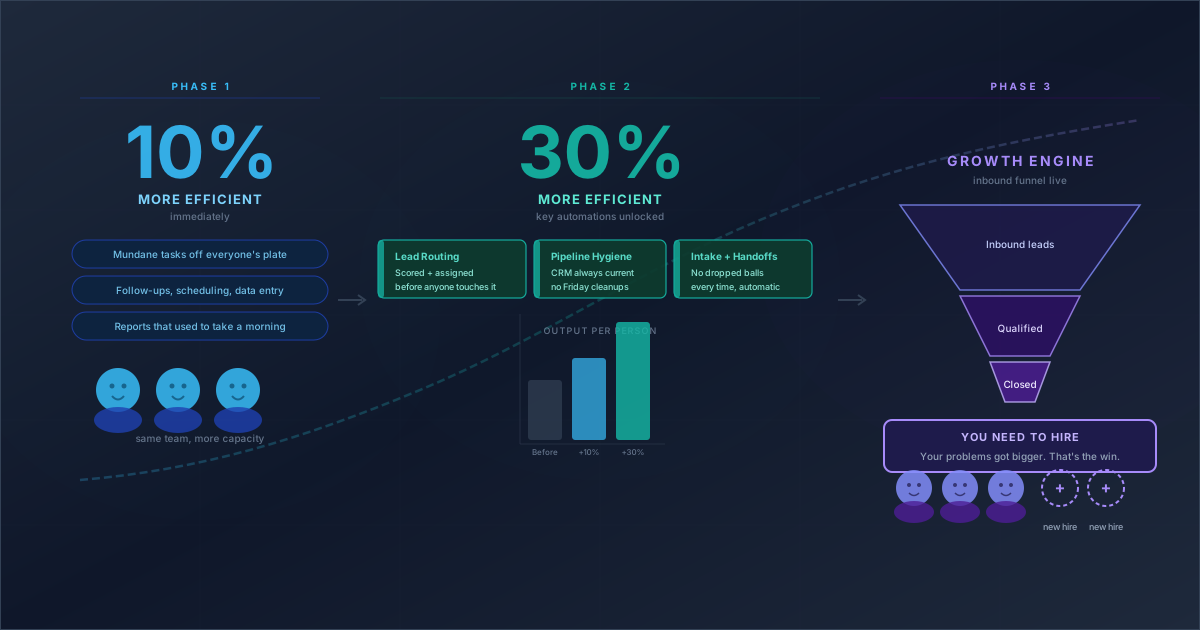
Phase One: Ten Percent, Immediately
The first thing AI does for most businesses is take the mundane off everyone's plate.
Not the hard things. Not the judgment calls. Not the client relationships or the strategic decisions. The low-grade, time-consuming work that happens in every job at every level: scheduling coordination, status update emails, report assembly, data entry that should have happened during the meeting but got pushed to end of day.
This work does not require talent. It requires attention. And attention, in a ten- or fifty-person company, is the scarcest resource you have.
When we deploy AI into an operation, the first observable result is usually in the first two weeks. The team gets roughly ten percent of their week back. Not from a headcount cut. From the work that was consuming hours without generating real value.
Ten percent sounds modest. For a team of ten, it is one FTE of capacity, recovered from work that was actively wasting the people you already have.
That is Phase One. It is not the destination. It is the starting point.
Phase Two: Thirty Percent, Once We Find the Key Automations
The second phase takes longer. Four to six weeks, sometimes more. It requires actually understanding how the business runs — the workflows, the tools, the handoffs, the places where information travels too slowly or not at all.
In every business we have worked with, there are two or three workflows that are doing more damage than the rest combined. They are not always obvious from the outside. They are usually invisible from the inside because everyone has adapted around them for so long that they feel like givens.
The most common patterns:
Lead routing. Inbound leads sitting uncontacted for hours or days because the process for getting them to the right person is manual. The lead goes cold. The rep follows up eventually. The close rate suffers. An automated scoring and routing system changes this immediately — every lead gets a response in minutes, assigned to the right person, with context already attached.
Pipeline hygiene. CRM data that lags reality by days or weeks because entry depends on reps remembering to update records after calls. Forecasts are built on guesses. Managers spend Friday afternoons chasing updates instead of coaching. When AI handles the data entry in real time, forecasts become reliable, managers get their Fridays back, and the pipeline tells the truth.
Intake and handoffs. The moment a deal moves from sales to delivery — or from intake to ops — is where things fall through most often. Documents missing, context not transferred, client having to repeat themselves. An automated handoff that packages everything the delivery team needs and routes it cleanly eliminates this class of problem entirely.
When you close these gaps, the team does not just do the same work faster. They operate differently. The sales rep who was spending a third of their week on follow-up logistics is now spending that time on actual selling. The ops lead who was chasing down missing information is now running the operation. The output per person changes in a way that a ten percent efficiency gain alone does not capture.
That is Phase Two. Thirty percent more from the same team. No new hires. Just the capacity that was already there, unlocked.
Phase Three: Build the Funnel. Create a Problem Worth Having.
Here is where the framing flips.
Phase One and Phase Two are about making your existing operation more effective. Phase Three is about growing the business until the operation cannot keep up.
The businesses that stay stuck — that get to thirty percent efficiency and stop — usually made AI an internal project. They optimized what they already had. They did not use the recovered capacity to go after new business.
The ones that break out use Phase One and Phase Two to create bandwidth, and then they use that bandwidth to build a growth engine.
For most of the businesses we work with, that means:
An outbound system that does not sleep. A multi-agent swarm that identifies target accounts, researches them, personalizes outreach, sends it at the right time, follows up intelligently, and flags warm responses for a human to close. Not a mass email blaster. A systematic prospecting operation that runs in the background while your team focuses on the prospects who are actually engaging.
Content that works while you are not. Thought leadership, search-optimized articles, case studies that answer the questions your best prospects are already asking. When this content is built and distributed consistently, it creates inbound demand — people who found you because they were looking for what you do, not because someone cold-emailed them.
A referral engine that does not depend on memory. Most referral business happens because someone happened to think of you at the right moment. An automated referral system makes sure that moment gets created intentionally — regular, personal touchpoints with past clients, framed around their needs, not your pipeline.
When these systems run together, the volume of inbound opportunity starts to exceed what the current team can handle. That is not a crisis. That is the signal that the model is working.
The Proof Is Hiring
The companies we have built this for do not tell us the model worked by pointing to a cost savings report.
They tell us because they needed to hire.
The ops lead who was the single point of failure for the entire operation — who could not take a vacation without things breaking — now has someone underneath them who can. The sales team that was managing thirty accounts each is now managing fifty, and they are looking for another rep. The founder who was doing both business development and delivery is finally separating those two jobs.
That is the outcome. Your problems get bigger. The right kind of bigger. The kind that means you are growing faster than your current team can absorb.
AI did not replace your people. It made your people more productive, unlocked the growth the business was capable of, and created the revenue to bring on the next generation of the team.
That is how you know it worked.
What This Looks Like in Practice
The businesses where this plays out most cleanly share a few traits.
They have a core team that is already good at what they do. AI makes good people exceptional. It does not fix a broken team.
They have a product or service that has real market demand. The growth engine finds buyers. It does not manufacture demand that does not exist.
They are willing to run the process — Phase One, then Phase Two, then Phase Three — rather than jumping straight to the funnel. The funnel built on top of a broken operation just creates more chaos. The sequence matters.
And they are willing to commit to ninety days before evaluating. Phase One is visible in two weeks. Phase Two takes four to six. Phase Three starts producing results at sixty days and compounds from there. The businesses that judge the model at thirty days are measuring the wrong thing at the wrong time.
The Question Worth Asking
The question that frames every engagement we run is not "How do we do the same with fewer people?"
It is: "What would this business look like if we could grow faster than we can currently hire for?"
That question produces a different plan. It produces a different roadmap. It produces a different outcome.
Efficiency is a means. The destination is a business that is doing more business, serving more clients, generating more revenue — and needing to bring on people to keep up with it.
That is the point of AI.
Start with a discovery session.
Frequently Asked Questions
Why three phases? Can we skip to Phase Three?
You can try. It usually does not work. A growth engine running on top of an operation that is still thirty percent admin-heavy creates bottlenecks faster than it creates revenue. The capacity you recover in Phase One and Phase Two is what makes it possible to absorb Phase Three inbound volume. The sequence is the model.
How long does each phase take?
Phase One shows results in the first two weeks — that is when the team first feels the time coming back. Phase Two takes four to six weeks to identify and close the key automation gaps. Phase Three starts producing inbound results at sixty days and compounds from there. A ninety-day window is enough to see all three phases in motion.
What kind of businesses does this work for?
Businesses with a core team that is already performing well, a product or service with real demand, and a willingness to run the process rather than jump to the end. Company size matters less than those three things. We have run this for five-person shops and fifty-person organizations. The pattern holds across both.
Does this require replacing our existing tools?
No. The model is built on top of your existing systems — CRM, email, project management, whatever you run on. AI connects to those systems; it does not replace them. The first thing we do in a discovery session is confirm what you have and where the integration points are.
What does the inbound funnel actually consist of?
It varies by business, but the core components are: outbound prospecting automation (identifying, researching, and reaching target accounts at scale), content that generates organic search and referral traffic, and a reactivation system that turns past clients into ongoing referral sources. Which of those gets built first depends on where the fastest return is in your specific operation.
How do we know when to hire?
The signal is when inbound volume is consistently exceeding what the current team can handle at the quality level you want to deliver. That is a good problem. It means the model is working. Our job is to help you recognize that signal early and build the hiring plan around it rather than scrambling to catch up.
Related Solutions
Get the AI Team Playbook
10 practical AI tools your team can start using today — automations, custom GPTs, AI agents, and prompt frameworks that actually save time.
Want to put this into practice?
Book a 30-minute call. We'll talk through how this applies to your business and where the biggest opportunities are.
Book a Discovery CallRelated Insights
Strategy
Why We Spend Four Hours Breaking Down Your Business Before We Build Anything
Discovery is not a sales meeting. It is the session where we map every workflow, find the bottleneck, and design the roadmap — before a single line of code gets written.
Read insightOperations
The Back-Office Tax: How Manual Workflows Cost Mid-Market Firms 20% of Their Week
There is a hidden tax inside most mid-market businesses. It does not show up as a line item, but it lives in rekeying, status checks, data copying, and error cleanup. Here is how to find it and remove it.
Read insightAgentic AI
A Trucking Maintenance Shop in Middle Tennessee Doesn't Need an Sdr Team. IT Needs a Swarm.
A shop owner who is great at fixing trucks shouldn't have to be great at sales too. We built an agent swarm that handles prospecting, qualification, follow-up, and booking — so the shop can grow without hiring people it can't afford.
Read insight