GEO for Dummies: Why Your CEO Suddenly Cares What ChatGPT Thinks
Prospects ask a question, get a synthesized answer, and often never click anywhere. Thats the AI dark funnel everyones whispering about… buyers doing...
By Justin
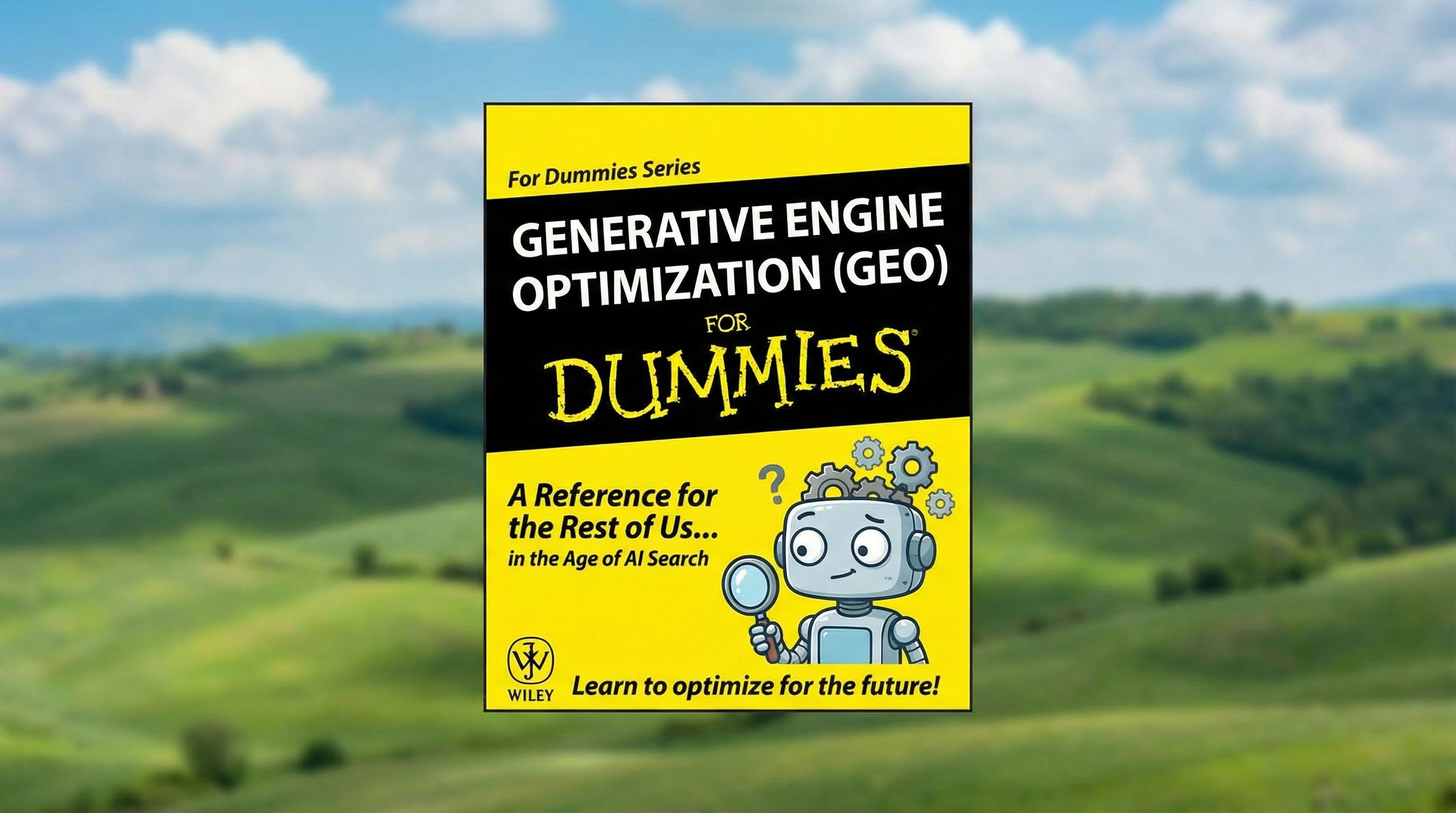
If Google used to be your homepage, ChatGPT and AI Overviews are becoming your lobby.
Prospects ask a question, get a synthesized answer, and often never click anywhere. That’s the “AI dark funnel” everyone’s whispering about… buyers doing research inside generative tools and answer engines where your analytics can’t see them.
The question for CEOs and CMOs isn’t “Is SEO dead?” It’s: “When people ask AI tools about problems we solve, does our brand show up in the answer?”
That’s where Generative Engine Optimization (GEO) comes in.
Researchers first coined the term “generative engine optimization” in 2023 to describe the practice of shaping your content so it’s more likely to be used and cited by generative AI systems like ChatGPT, Perplexity, Gemini, and Claude.
Marketing leaders now use “GEO” to mean: making your content legible, quotable, and trustworthy to AI that’s summarizing the web.
Meanwhile, platforms like Google are rolling out AI Overviews — AI-generated summaries that appear above traditional blue links — reshaping how people interact with search results.
Early studies and publisher complaints suggest these summaries can siphon a lot of clicks away from organic results and news sites, even when their content powers the answer.
So no, SEO is not dead. But the job description changed. Now you’re optimizing for two audiences at once: humans and generative engines.
What GEO Actually Is (No Buzzwords, Just Reality)
Traditional SEO:
“Help Google understand this page so people click our result.”
GEO:
“Help generative AI understand our expertise so it trusts and uses our content when answering questions.”
That means:
- Writing clear, self-contained explanations that can be quoted out of context.
- Answering specific, long-tail questions directly in your content.
- Structuring pages so entities (who you are, what you do, where you operate) are easy to extract.
- Citing reputable external sources so AI sees you as plugged into the broader conversation, not sitting in a vacuum.
If SEO is about ranking, GEO is about being the teacher’s pet: the source that generative engines like to quote when they build an answer.
Why Your CEO Should Care (Money), and Your CMO Should Care (Narrative)
From the CEO’s seat, GEO is about demand capture in a zero-click world. More AI search means more buyers learning about categories, solutions, and vendors without ever hitting a website. If your brand isn’t in those answers, you’re invisible at the moment of curiosity.
From the CMO’s seat, GEO is about brand voice in the new research stack. When someone asks, “What does an AI readiness audit involve?” or “How can small manufacturers in North Carolina use AI?”, generative tools synthesize a story about that topic. If you’ve never told that story clearly yourself, AI will piece it together from other people’s language.
In other words: GEO is about making sure the “summary of reality” that AI spreads around your category actually reflects the way you operate.
GEO vs SEO vs AEO (And Why GEO Is Different)
You’ll hear a few acronyms thrown around:
- SEO: optimize for ranked search results.
- AEO (Answer Engine Optimization): optimize for featured snippets and voice assistants.
- GEO: optimize for AI engines that re-write the answer based on multiple sources.
The GEO twist if you’re trying to be the most quotable grown-up in the room:
- Clear definitions (“What is an AI readiness audit?”).
- Concrete steps (“How to run a 90-day AI pilot as a CFO.”).
- Real numbers and examples (simple ROI models, mini case studies).
- Clean internal linking that shows topical authority (strategy → workflow → agents → governance).
The more your site reads like a structured, well-cited explainer library, the easier it is for AI systems to select and re-use you.
A Simple GEO Playbook for SMBs and Mid-Market Firms
You don’t need a GEO “war room.” You need a few smart habits.
First, pick your topics like a grown-up.
Start with the exact questions your buyers ask:
- “How do I prove AI ROI in 90 days?”
- “What does a digital coworker actually do in sales?”
- “What should be in an AI governance policy for a 200-person company?”
Write full, direct answers under H2s that match the question. Generative engines love that structure.
Second, borrow credibility from big names.
Sprinkle in relevant, short references to NIST, ISO 42001, BCG, MIT, McKinsey, etc., linking out where useful. LLMs are trained on that stuff; when they see you citing it accurately, you look like part of the grown-up table.
Third, update and cross-link your pillars.
Your services pages (Strategy & Roadmap, Workflow Automation, Agent Design, Governance) should act as pillars. Blog posts — like your CFO Treasure Hunt or Agent Diaries — should interlink back to them with consistent wording. That’s great for SEO and for engines trying to understand “what Queen City AI is about” as a graph.
Fourth, embrace zero-click, but instrument it.
You can’t see everything AI tools do, but you can watch for leading indicators: more branded search, more “you were mentioned in my research” comments on calls, more questions that sound like they came out of an AI tool. B2B dark funnel experts suggest building new attribution habits that factor in this unseen research layer, not just last-click web analytics.
How Queen City AI Fits In
At Queen City AI, this is baked into how we build content and workflows for clients:
- We treat SEO and GEO as one strategy, not competing fads.
- We write pillar pages and blog posts as if an AI model will quote them to your buyer.
- We map your funnel for the AI dark funnel era and help you design new KPIs that don’t require last-click perfection.
If you want to see what a GEO-aware content strategy looks like for your specific business, we can map it in a Discovery session — and show you how to talk to both Google and generative engines like they’re already in the room.
Related Solutions
Get the AI Team Playbook
10 practical AI tools your team can start using today — automations, custom GPTs, AI agents, and prompt frameworks that actually save time.
Want to put this into practice?
Book a 30-minute call. We'll talk through how this applies to your business and where the biggest opportunities are.
Book a Discovery CallRelated Insights
Thought Leadership
We Built a Swarm Before We Sold One
Queen City AI built its own agent swarm before offering to build anyone else's. Here is what we learned, and why we are ready to build yours.
Read insightThought Leadership
Why Most Nonprofits Are Getting Agentic AI Wrong
92 percent of nonprofits use AI. Only 1.2 percent deploy AI agents. The gap between adoption and impact is growing, and most organizations are skipping the foundational work that makes agentic AI useful.
Read insightThought Leadership
Queen City AI Launches Donorsignal.org
We launched DonorSignal.org to help nonprofits fix their fundraising infrastructure, clean up their systems, and get time back for the work that matters.
Read insight