AI Agents vs. AI Copilots: Which One Actually Fits the Workflow?
A copilot helps a person do the work faster. An agent handles a defined workflow. If you confuse the two, you usually end up buying software that sounds impressive and changes very little operationally. Here is how to tell which one your business actually needs.
By Justin Hinote
Most teams asking about AI are really asking a workflow question.
They may not phrase it that way. They usually ask whether they need a copilot, an agent, a chatbot, or a stack of tools.
That is usually the wrong place to start.
The better question is this: what kind of work are we actually trying to change?
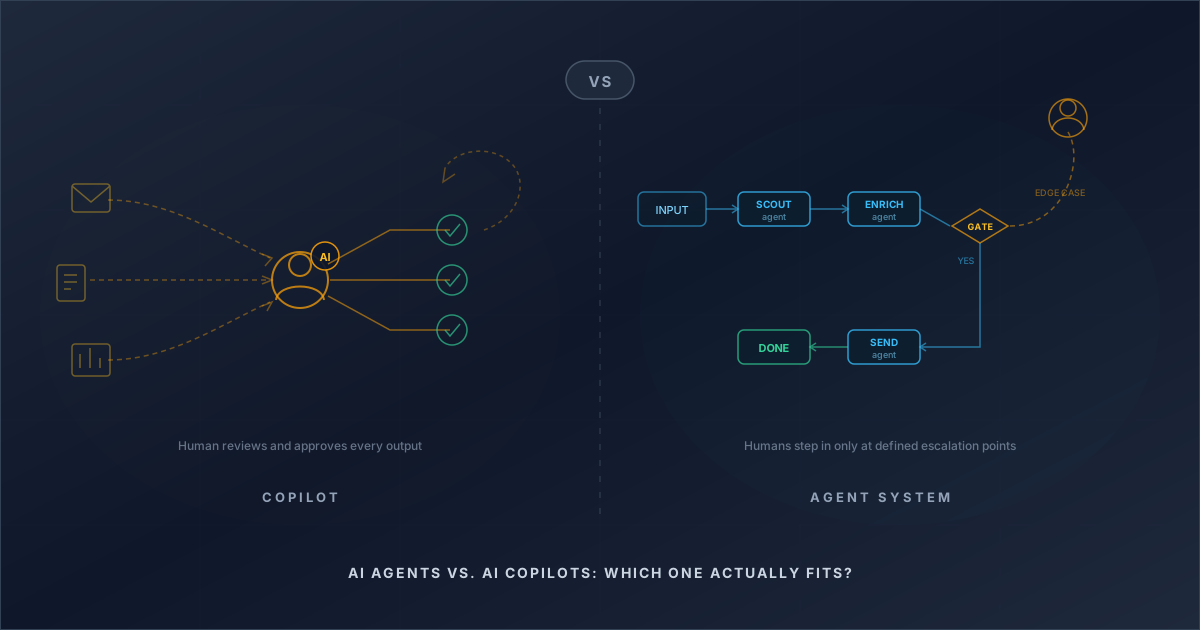
Because a copilot and an agent are not the same thing. They solve different problems. One helps a person do the work faster. The other handles a defined workflow with guardrails, escalation rules, and accountability built in. If you confuse the two, you usually end up buying software that sounds impressive and changes very little operationally.
A Copilot Helps Inside the Task
A copilot is there to assist a human while the human stays in the driver's seat.
It helps draft the email. Summarize the meeting. Clean up the notes. Suggest next steps. Review a document. Pull together a first pass. In most cases, the human still decides what to do, when to do it, and whether the output is good enough to use. That makes copilots useful in judgment-heavy work where context changes often and a person still needs to stay close to the decision.
That is why copilots often fit sales reps, account managers, recruiters, technicians, or operators who have to think through edge cases all day. The value is speed, not delegation. A good copilot reduces friction inside the task. It does not remove the workflow around the task.
An Agent Handles the Workflow
An agent is different.
An agent is not just helping someone work faster. It is handling a bounded process on its own. That process might involve pulling data from multiple systems, checking for conditions, taking the next step, passing work to another agent, and escalating to a human only when something falls outside the rules. That is much closer to how Queen City AI designs agent systems today: specialized agents with defined jobs coordinating through signals to complete work around business logic.
That distinction matters because operational impact usually comes from workflow redesign, not just assistance inside one step. If a person still has to wake up, open five tools, reconcile the inputs, make routine handoffs, and push the process forward manually, then the business is still carrying the back-office tax even if the writing got faster.
Why Companies Confuse Them
A lot of teams say they want agents when what they really want is better assistance.
A lot of other teams buy copilots when what they really need is workflow execution.
That confusion happens because the market tends to package everything as "AI" and leave the operating model vague. But the difference is practical. If the work is mostly human judgment, a copilot is usually the right first move. If the work follows a known path most of the time and the pain is in routing, enrichment, follow-up, or coordination, then an agent system is usually the better fit.
That is also why starting with the tool leads so many teams into the weeds. When the first question is "Which AI platform should we buy?" the result is usually one more layer of software wrapped around the same messy process. When the first question is "Where is labor being consumed without adding judgment?" the design path gets much clearer.
Where Copilots Make Sense
Copilots tend to work best where context shifts constantly and the human still needs to own the outcome.
That includes drafting follow-up emails after calls, summarizing meetings, helping a seller prepare for an account review, generating first-pass content, reviewing contracts or proposals, or helping a technician or coordinator process information faster. In those environments, the value is real, but it is assistive. The person is still the workflow.
That is not a weakness. It just means the gain is usually measured in speed and consistency at the individual level. A strong copilot can help good people move faster. It usually does not remove the need for the person to move the work from one stage to the next.
Where Agents Make Sense
Agents make more sense when the workflow is repeatable, multi-step, and already follows a pattern most of the time.
Think prospect research, lead qualification, enrichment, intake routing, first-response workflows, follow-up sequencing, recurring reporting, document review with clear thresholds, or operations tasks buried in inboxes and spreadsheets. These are the cases where the business is not paying for judgment so much as it is paying for orchestration.
This is also where companies start to feel leverage instead of just convenience. When an agent handles the repetitive coordination layer, the team is no longer spending time pushing work through the system manually. People step in when judgment is actually needed, not because the process has no better way to move.
The Governance Line Matters
This is where a lot of AI content gets sloppy.
Not every workflow should be handed to an agent without guardrails. Some tasks are fine in read-only mode. Some are safe if they require approval before writing to a system of record or sending an external message. Some should stay human-controlled from end to end. Queen City AI's approach to security and governance reflects that distinction through least-privilege design, human approval gates on high-stakes or irreversible actions, and auditability by default.
That is a much more useful framing than asking whether a company is "ready for autonomous AI." The real question is narrower. Which parts of the workflow are safe to delegate, which parts require review, and which parts should remain fully human? Once you answer that, the architecture usually becomes obvious.
Most Teams Should Not Start With Full Autonomy
This is the part that gets lost in a lot of agent hype.
Most businesses do not need full autonomy on day one. They need clarity. They need a map of the workflow. They need a measurable problem. They need to know where the exceptions live. That is consistent with how we structure an AI engagement: start small, prove it, scale up.
In practice, that often means starting with a copilot or semi-autonomous workflow in one area, measuring what changes, and then deciding whether the process should stay assistive or move toward agent execution. The smartest path is usually not "replace the team." It is "remove the manual coordination layer first, then expand carefully where the risk is low and the payoff is clear."
A Simple Decision Frame
If the work depends on human judgment at every step, start with a copilot.
If the work follows a known path, contains repetitive handoffs, and can be bounded by rules with clear escalation points, design an agent.
If you cannot explain the workflow, measure the drag, or identify where exceptions happen, do not buy either one yet. Map the process first. That is the only reliable way to tell whether you need assistance, execution, or both.
The Real Goal
The goal is not to say you are using agents.
The goal is not to say your team has a copilot.
The goal is to make the business move better.
Sometimes that means helping a person do the work faster. Sometimes it means redesigning the workflow so the person is no longer stuck doing work the system should have handled. If you start there, the copilot-versus-agent decision becomes much less abstract and a lot more useful.
Frequently Asked Questions
What is the difference between an AI copilot and an AI agent?
A copilot helps a person complete a task faster. An agent handles a defined workflow on its own within the guardrails you set. The difference is assistance versus execution.
Should companies start with copilots or agents?
It depends on the workflow. If the work requires human judgment all the way through, start with a copilot. If the work is repeatable, rules-based, and slowed down by manual coordination, an agent system is often the better fit.
Are AI agents always autonomous?
No. In well-designed systems, autonomy is scoped. Many agent workflows operate with approval gates, read-only access, escalation rules, and audit trails so the team stays in control of higher-risk actions.
What kinds of workflows are best for agents?
The best candidates are repeatable workflows with high volume, clear steps, and measurable drag. Common examples include intake, lead research, enrichment, routing, follow-up, document handling, and status reporting across multiple systems.
How do we know if our workflow is ready for an agent?
If you can describe the steps, identify the exceptions, and point to where time disappears — you are ready to design an agent. If the process is still undefined or varies widely by person, map it first before trying to automate it.
Related Solutions
Get the AI Team Playbook
10 practical AI tools your team can start using today — automations, custom GPTs, AI agents, and prompt frameworks that actually save time.
Want to put this into practice?
Book a 30-minute call. We'll talk through how this applies to your business and where the biggest opportunities are.
Book a Discovery CallRelated Insights
Agentic AI
A Trucking Maintenance Shop in Middle Tennessee Doesn't Need an Sdr Team. IT Needs a Swarm.
A shop owner who is great at fixing trucks shouldn't have to be great at sales too. We built an agent swarm that handles prospecting, qualification, follow-up, and booking — so the shop can grow without hiring people it can't afford.
Read insightThought Leadership
We Built a Swarm Before We Sold One
Queen City AI built its own agent swarm before offering to build anyone else's. Here is what we learned, and why we are ready to build yours.
Read insightSecurity
Queen City AI Security Fundamentals
How we design AI systems for high-trust environments — layered defense, Zero Trust, security-by-design for agents, and responsible AI governance.
Read insight