The Exception Economy of Waste Collection
Ask anyone who has sat in a dispatch chair or ridden a route for a week and they will tell you the same thing. Waste operations are not run by plan. They...
By Justin
Why “Normal Days” Don’t Exist
Ask anyone who has sat in a dispatch chair or ridden a route for a week and they will tell you the same thing. Waste operations are not run by plan. They are run by exceptions.
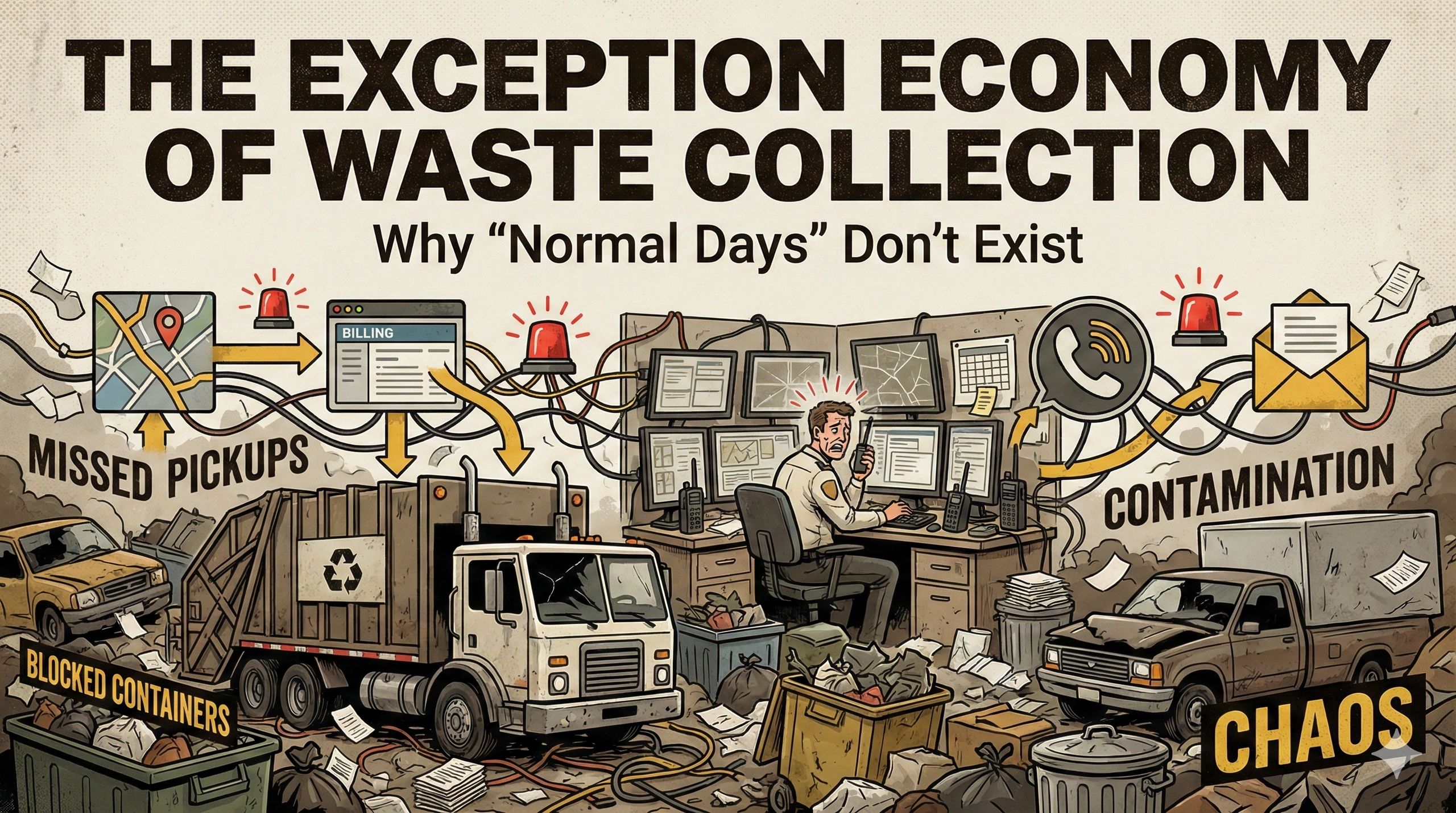
The plan is the schedule, the route sheet, the service promise, the list of stops. The day is everything that interferes with it: missed pickups, blocked containers, contamination, overflow, route drift, vehicle breakdowns, last-minute changes, and the never-ending ripple effects that follow. In most organizations, those exceptions are handled with a mix of radio calls, texts, handwritten notes, spreadsheets, and heroics.
That works until it doesn’t. And when it doesn’t, the costs show up everywhere.
Waste is exception driven, and systems are fragmented
Most haulers do not have a single operational truth. They have a routing tool, telematics, a billing or ERP system, a customer service tool, email, and whatever workarounds have accumulated over the years. The result is that one event in the field spawns multiple disconnected workflows inside the business. A blocked container becomes a driver note, then a dispatch call, then a customer complaint, then a billing dispute, then a credit, then a manager review, then a follow-up route, then another call. The same exception can be “true” in one system and invisible in another.
This is why waste operations often feel like they are constantly catching up. Not because people are not working hard, but because the work is inherently reactive and the information loop is broken.
The hidden cost of chaos is bigger than most teams model
The most obvious cost of an exception is the extra time and fuel. The more damaging costs are the compounding ones:
- Recovery truck rolls and repeat visits that chew up capacity and blow up overtime
- Dispatcher workload that scales with exception volume, not with route volume
- Call volume spikes driven by lack of real-time status and proof-of-service
- Billing leakage from credits, waived fees, and unresolved disputes
- SLA exposure for municipal and commercial contracts where service failures have penalties
- Operational credibility loss with customers, property managers, and municipalities
In many operations, the same root problem appears in different departments with different names. Operations sees a missed pickup. Customer service sees a complaint. Finance sees a credit request. Leadership sees margin pressure.
When you look at exceptions end-to-end, the economics get ugly fast. Industry benchmarks cited in the WasteOps research highlight that “truck roll” costs are often materially underestimated when labor, vehicle wear, scheduling disruption, and opportunity costs are included.
Why missed pickups create disproportionate downstream damage
A missed pickup is rarely just a missed pickup. It is usually a cascading failure across service, communications, and billing.
Operationally, the recovery decision matters. Do you send the same truck back. Do you reroute a nearby truck. Do you reschedule to tomorrow. Do you tag it for review. Each choice has cost, SLA implications, and customer impact.
Customer-facing, it triggers uncertainty. If the customer cannot see what happened and what will happen next, they call. If you cannot provide proof-of-service or a clear reason, you absorb escalation and churn risk.
Financially, it often ends in a credit. Sometimes a justified credit, sometimes a defensive credit because the business cannot quickly prove what occurred. That is where revenue leakage becomes a persistent tax on the operation.
Blocked access, overflow, and contamination are not edge cases
If you operate residential, multifamily, or commercial routes, you already know blocked access and overflow are not rare. They are routine. A driver arrives to a locked gate, a car parked in front of the enclosure, a compactor jammed, a container overfilled, or a cart contaminated enough to trigger a policy question.
The operational challenge is that these exceptions require context and policy. Is a return visit included in the agreement. Is an extra pickup billable. Is there a contamination fee. Does the municipal contract allow certain actions. Does the customer need notification. Does a photo need to be attached for enforcement or billing.
Without a tight evidence loop, the organization ends up with inconsistent outcomes. Some drivers document. Some don’t. Some dispatchers apply the policy. Some improvise. Some customer service reps issue credits to end the call. Over time, that inconsistency becomes both a margin drain and a trust issue.
The core operational problem is not visibility. It is closed-loop resolution.
A lot of technology in waste has focused on visibility: dashboards, route monitoring, GPS breadcrumbs, and reporting. Those tools help, but visibility alone does not resolve exceptions. It merely helps humans notice them.
The real operational lift is the full loop:
- Detect the exception early enough to matter
- Decide the next best action in a way that aligns with policy and contract realities
- Execute the workflow across dispatch, customer communication, and billing steps
- Verify completion with evidence
- Record the outcome so the system learns what works
Most waste operations do step one and sometimes part of step two. Steps three through five are where the real cost and labor sit.
Why adoption is hard even when ROI is obvious
If the savings are real, why is adoption uneven across the industry?
The answer is boring but true: integration and change management.
A lot of software deployments fail not because the feature set is weak, but because the organization cannot get clean data into the tool, cannot connect it to billing and customer workflows, or cannot get drivers and dispatchers to change habits under pressure. The WasteOps research cites common failure modes: unclear requirements, insufficient involvement of frontline staff, weak process definition, limited IT support, and inadequate training.
This is why “overlay-first” approaches resonate in waste. If you can start by unifying operational reality without ripping out core systems, you can prove value before asking the organization to bet the farm.
What operators actually want from technology
Operators do not want a platform. They want relief.
Relief looks like:
- Fewer missed pickups that become emergency recoveries
- Fewer truck rolls created by preventable exceptions
- Lower call volume because customers get proactive updates and proof
- Fewer billing disputes because evidence and policy are tied together
- Less dispatcher overload because repetitive exception workflows are handled consistently
That framing matters, because the buying center in waste is practical. Operational leaders buy pain relief. Finance buys margin protection. IT buys lower-risk integration and governance.
A practical way to think about modernization in waste ops
If you are leading operations, IT, or finance in a hauling organization, a useful mental model is to modernize around the exception lifecycle, not around the org chart.
Start by identifying the exception types that:
- Create repeat work and extra visits
- Trigger the most calls and escalations
- Create the most credits, disputes, and fee leakage
- Put you at SLA risk
Then map what it takes to close the loop: the data you need, the evidence you need, the policy decisions you need, and the workflow steps you need across teams.
This is also where pilot thinking is valuable. A narrow deployment that reduces exception handling time, recovery visits, and dispute cycles on one region or route slice can prove the case quickly without requiring a massive transformation.
The takeaway
Waste is not a “set it and forget it” operation. It is a high-frequency exception environment where small failures cascade into labor, fuel, call volume, and margin loss.
The organizations that win over the next few years will not be the ones with the prettiest dashboards. They will be the ones that can consistently detect and resolve exceptions end-to-end, with evidence, policy alignment, and operational speed.
That is the path from firefighting to control.
Get the AI Team Playbook
10 practical AI tools your team can start using today — automations, custom GPTs, AI agents, and prompt frameworks that actually save time.
Want to put this into practice?
Book a 30-minute call. We'll talk through how this applies to your business and where the biggest opportunities are.
Book a Discovery CallRelated Insights
Insight
How I Use AI to Become a Better Youth Sports Coach
Basketball is ending. Soccer and baseball are starting. AI is helping me keep up. Purpose-built coaching assistants for youth sports workflows.
Read insightInsight
Why Pre-Built Stacks Are Obsolete for Enterprises
In todays fast-paced digital landscape, enterprises are rapidly evolving beyond the limitations of pre-built stacks. Organizations in regions like Charlotte...
Read insightInsight
Maximizing Business Efficiency with AI Workflow Automation
Step into a new era of operational excellence where AI-driven workflow automation transforms traditional business processes. This section uncovers the...
Read insight